In a recent past, there has been a trend to decrease the use of metals within the body. The trend now involves the increased use of zirconia dental implants as an alternative to titanium. Patients often ask whether zirconia implants are better than titanium. This boils down to what is most important for the patient.
Understanding Zirconia Dental Implants
Dental implants are replacement for your natural tooth roots. Where your tooth roots are missing an implant is inserted and acts like your natural root. Titanium has been used as an implant material since the 1960's and is still widely regarded as the material of choice. The implant provides a long term success rate that exceeds 94%.
Zirconia implants were first marketed back in 1987 and have only recently gained popularity among patients seeking holistic or metal free treatment options. Research, manufacturing and Implant Dentist Beverly Hills developments are further enhancing their clinical performance.
What Are Zirconia Implants Made Of?
While zirconia is marketed as a metal-free alternative it is in fact a ceramic, zirconium dioxide (ZrO). The term ceramic is derived from a mixture of metallic and non-metallic elements bonded together.
Zirconium is a transition metal and oxygen is a non-metal, these elements combine to produce an oxide ceramic with distinct physical and chemical properties from metal when used to make them into zirconia. Because of this zirconia dental implants are ceramic not metallic,
Zirconia vs. Titanium: Which Is Better?
There is no one size fits all answer to this question. Titanium restorations have stood the test of time based on scientific evidence, clinical research and 30 plus year successful results.
An alternative seems to be zirconia. It has been suggested that it shows superior bio compatibility, natural aesthetics and a good soft tissue response. It has also been reported that oscillation between both materials is similar, and that the level of BIC is comparable between both materials.
Your optimal selection will be based upon your clinical needs, aesthetic desires, and personal preferences.
[caption id="" align="aligncenter" width="1125"]
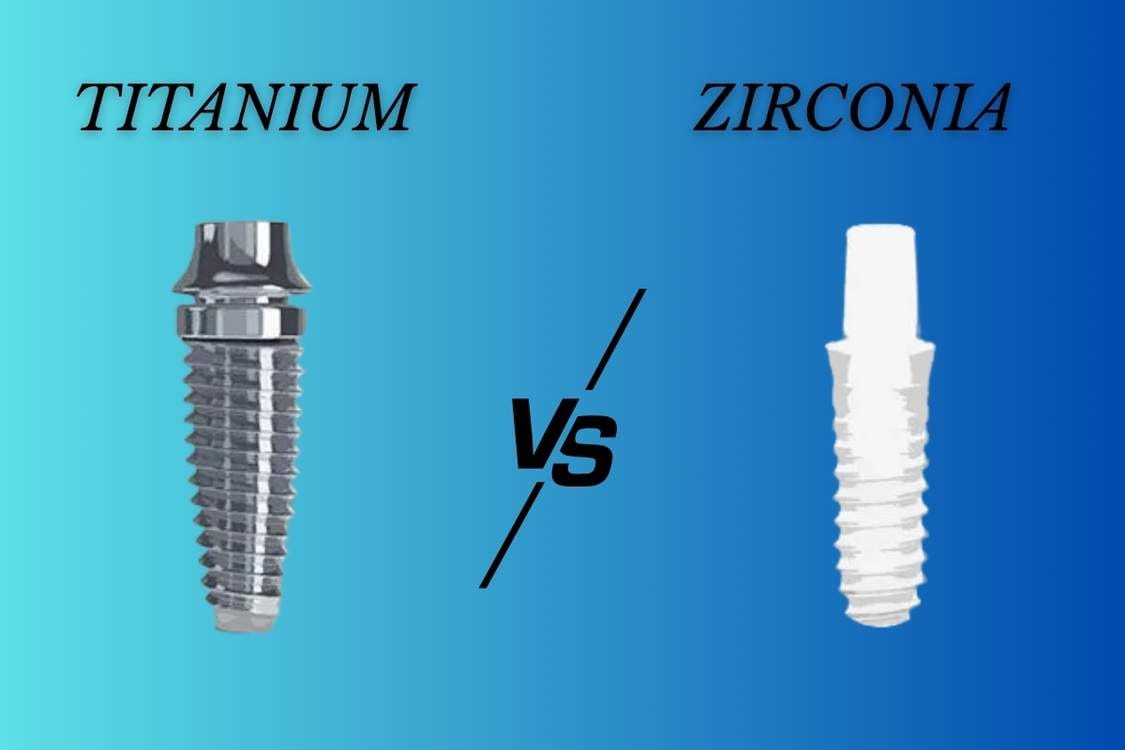 Titanium vs Zirconia[/caption]
Advantages of Zirconia Dental Implants
Natural Appearance
The white color of zirconia is very similar to natural teeth and is an excellent choice where aesthetics are important. It does not show the white grey color under the gum tissue like titanium does.
Suitable for Metal-Sensitive Patients
While genuine titanium allergies are rare, certain patients opt against metal-based restorations. Because titanium implants can have varying levels of other metals according to the manufacturer, zirconia is a promising option for patients seeking a ceramic-based solution.
Reduced Plaque Accumulation
A few clinical studies indicated that zirconia surfaces could be more plaque and bacterial resistant, thus having a lower risk of peri-implant inflammation.
Excellent Corrosion Resistance
Zirconia is very corrosion resistant, and was found not to degrade under intra-oral conditions, helping to ensure lasting stability.
Low Electrical and Thermal Conductivity
Since zirconia is a poor electrical and thermal conductor, it avoids the risk of electrolytic reactions sometimes observed between two dissimilar metals.
Disadvantages of Zirconia Dental Implants
Limited Implant Designs
Fewer options, both in terms of the variety of designs and restorative components, are available with the zirconia systems than with Ti2. This trend may make treatment planning more difficult in the short-term, especially in patients where multiple implant restorations are expected.
Limited Long-Term Clinical Evidence
Although the research is promising, zirconia implants simply don't have decades of documented clinical success like titanium implants. We need more long-term studies.
Lower Fracture Resistance
While zirconia is very strong in compression it is more brittle than titanium and less able to withstand bending forces. This increases the risk of fracture in some situations.
Challenges with Small-Diameter Implants
Zirconia implants, that are thinner than standard when placed in limited bone space, may be more prone to fracture compared to titanium implants. This may mean that they are not suitable in situations where smaller implant diameters are indicated.
Less Suitable for Full-Arch Restorations
Patients who are replacing all or most of their teeth today require advanced systems with an extensive range of prosthetic components. Titanium systems are providing far more flexibility than other systems in these advanced cases and are therefore the system of choice.
Are Zirconia Dental Implants Safe?
Are zirconia dental implants safe?
Are zirconia dental implants biocompatible?
Are they a risk-free alternative?
Yes, zirconia dental implants are safe and biocompatible.
They have many benefits, such as biocompatibility, corrosion resistance and a great natural appearance.
Nevertheless, the material itself has it limitations in long term clinical evidence, design flexibility and fracture strength in some circumstances.
Titanium implant are on the top of the extensive research and most popular choice of implant material for the past thirty years.
At the end of the day, it is a personal decision on which material you choose. It is best to speak with your dentist who can go through their options with you and find the best solution for you.